

Most people never expect to look up at their ceiling and wonder if it’s about to fall.
Unfortunately, that’s exactly the situation one of our recent customers in Naperville found themselves in. What started as a normal day quickly turned into an emergency after part of their bedroom ceiling collapsed. Instead of planning a remodeling project or making cosmetic updates, they were suddenly dealing with drywall, insulation, and dust throughout their home.
As stressful as that situation was, there was one thought we couldn’t shake.
It probably could have been prevented.
This wasn’t the first ceiling collapse we’ve been called out to repair, and over the years we’ve noticed something interesting. Nearly every ceiling that has failed gave the homeowner warning signs long before it finally came down. The problem is that most people don’t know what those signs mean. They assume a few cracks, a couple of nail pops, or a slight sag are simply part of living in an older home.
Sometimes that’s true.
Other times, your ceiling is trying to tell you that something much more serious is happening.
If your home was built between the 1940s and early 1980s—as many homes throughout Naperville, Wheaton, Glen Ellyn, Hinsdale, Clarendon Hills, Lisle, Downers Grove, Elmhurst, and the surrounding DuPage County area were—this is something worth paying attention to.
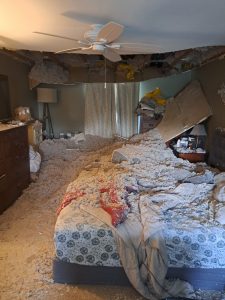
One of the biggest misconceptions we hear is that ceilings simply collapse without warning.
In our experience, that’s rarely the case.
More often than not, homeowners notice something that just doesn’t look quite right. Maybe they see a slight dip in the ceiling while they’re lying in bed. Perhaps a few nail pops appear that weren’t there before. Then a crack develops. A few months later, another crack appears running in the same direction. Sometimes the drywall even starts separating where it meets a beam or wall.
Individually, none of those things necessarily seem alarming.
Together, however, they often tell a very different story.
As the drywall begins pulling away from the framing, the weight is transferred to fewer and fewer fasteners. Once enough nails have loosened, the remaining ones are forced to carry far more weight than they were ever intended to support. At that point, the ceiling may continue sagging for weeks—or it may fail much sooner.
That uncertainty is exactly why these situations should never be ignored.

Although our recent emergency project in Naperville reminded us how quickly these situations can develop, another homeowner comes to mind whenever we talk about ceiling collapses.
She called us in complete panic.
She had noticed her ceiling beginning to separate, and she knew something wasn’t right. What she didn’t know was what she was supposed to do next.
Should she spend a week gathering estimates?
Should she call her insurance company first?
Was this actually dangerous, or was she overreacting?
Like many homeowners facing an unexpected problem, she felt completely overwhelmed. Finding a contractor you can trust is difficult enough when you’re planning a kitchen remodel. When you think your ceiling may fall at any moment, making decisions becomes even harder.
Fortunately, she decided to call us.
Alex, one of our estimators, rearranged his schedule and visited her home that same day.
After inspecting the ceiling, he confirmed what she was already beginning to suspect.
There wasn’t enough time left to prevent the collapse.
The ceiling had deteriorated to the point where failure was inevitable.
To make matters even more challenging, it happened near the end of the week. Our production schedule was already full, and every crew was committed to other projects.
But some jobs simply can’t wait.
That evening, before the ceiling gave way, our crew arrived to protect the home. Floors were covered, adjoining rooms were sealed off with plastic, and dust containment was installed throughout the work area.
Not long afterward, the ceiling collapsed.
While we couldn’t stop gravity, we were able to prevent what could have been a much larger disaster. Instead of drywall dust spreading throughout the home, insulation covering furniture, and debris damaging additional finishes, the mess was largely contained to the protected area. Once everything was safe, we returned to remove the damaged materials and rebuild the ceiling properly.
Looking back, the homeowner told us she was incredibly relieved she made that phone call when she did.
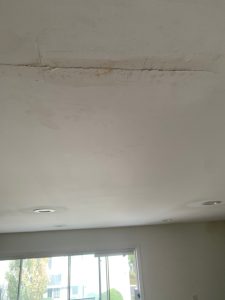
Fortunately, not every story ends with a ceiling on the floor.
A homeowner in Clarendon Hills contacted us after noticing that the ceiling in several rooms appeared to be sagging. Her home had been built in 1981, and she had recently added more insulation in the attic. Over time she began noticing that parts of the drywall looked like they were separating from the framing. Fresh cracks had appeared alongside older ones, and she also knew the previous owners had experienced a ceiling collapse in another room years earlier.
Those details immediately raised concerns.
When we inspected the home, we found that the drywall was beginning to loosen but had not yet reached the point of failure.
Instead of replacing entire ceilings, we were able to reinforce the existing drywall by installing modern drywall screws into the affected areas. After securing the loose sections in the living room, master bedroom, and guest bedroom, we patched, finished, and repainted the repaired ceiling surfaces.
The project was relatively straightforward because she called before gravity took over.
Today, she has the peace of mind of knowing her ceilings have been reinforced, and she no longer worries every time she notices a small crack overhead.
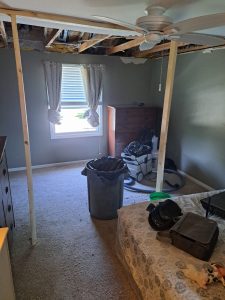
Many people assume repairing a collapsed ceiling simply means hanging a new piece of drywall.
In reality, replacing the drywall is only one part of the job.
Once drywall falls, it usually brings insulation with it. Fine drywall dust has a way of finding every corner of a home, and if the area isn’t properly contained, it can spread far beyond the room where the collapse occurred.
That’s why our first priority is protecting the rest of the house before major demolition begins.
We carefully cover flooring with protective materials, install dust containment barriers, and seal off nearby rooms to keep debris from traveling throughout the home. Once everything is protected, the collapsed drywall is removed, reusable insulation is salvaged whenever possible, and the remaining ceiling drywall is taken down safely.
Only after the damaged materials are removed do we begin rebuilding the ceiling. New blocking is installed wherever additional support is needed, followed by new drywall fastened with modern drywall screws instead of nails. The new ceiling is taped, mudded, sanded, primed, and painted so the repair blends seamlessly with the rest of the room.
If debris has damaged carpet or flooring below, those finishes may also need to be replaced as part of the restoration process.
While every project is unique, the goal is always the same: restore the room as though the collapse never happened.

This is another question we hear quite often.
The answer depends on your individual homeowner’s insurance policy and what caused the damage in the first place.
Some ceiling collapse repairs may be covered if they result from a sudden covered event. Others may not be covered if the damage is determined to be the result of long-term wear, aging materials, or deferred maintenance.
If you’re unsure, it’s always worth contacting your insurance company as soon as you notice significant ceiling movement or immediately after a collapse. Taking photographs before cleanup begins can also be helpful if a claim is filed.