What Should I Ask a Contractor Before Hiring Them?

6 Questions That Could Save You Thousands

If you’re planning a bathroom remodel, kitchen renovation, basement finishing project, or a complete home remodel, you’ve probably heard the same advice repeatedly:

“Make sure your contractor is licensed, bonded, and insured.”

While those items are certainly important, we’ve found they don’t always tell the whole story.

At Classic Remodeling, many of the homeowners who contact us have already had a bad experience with another contractor. We’ve heard countless stories of contractors taking deposits and disappearing, projects left unfinished, poor workmanship, missed inspections, and every excuse imaginable, from family emergencies to injuries to simply becoming impossible to reach.

Because of those conversations, we’ve developed our own list of questions homeowners should ask before hiring a remodeling contractor.

These recommendations are based on our personal experience and opinions. Every homeowner’s situation is different, and there may be other factors worth considering when making your decision. However, the following questions have consistently helped homeowners avoid some of the most common and costly mistakes we see throughout the remodeling industry.

The Truth About "Cheap, Fast & Good"

There is an old saying in construction:

You can have it cheap, fast, or done right—pick two.

Over many years in the remodeling industry, we’ve become convinced that the combination of cheap, fast, and high-quality simply does not exist.

Here’s why:

  • If it’s cheap and fast, it usually isn’t done correctly.
  • If it’s cheap and done correctly, it probably won’t be fast.
  • If it’s done correctly and completed quickly, it shouldn’t be cheap.

Many homeowners understandably want all three. Unfortunately, that’s often where problems begin.

Professional remodeling contractors become efficient because they’ve spent years, sometimes decades, developing their skills, refining their processes, training their employees, and learning from experience.

A good comparison is the medical field.

Imagine two people performing the same procedure. One is a highly experienced surgeon who has successfully performed the procedure thousands of times. The other is a medical student observing it for the first time.

The experienced surgeon may complete the procedure faster, but nobody would expect the surgeon to charge less simply because they were more efficient. In fact, they command a higher fee because of the knowledge, skill, and experience they’ve accumulated over many years.

The same principle applies to remodeling.

A professional contractor who can complete a project efficiently without sacrificing quality has earned that efficiency through years of experience. Homeowners should view speed as a sign of competence; not as a reason to negotiate a lower price.

In many remodeling disasters we’ve encountered, the homeowner wasn’t intentionally looking for poor workmanship. They were simply trying to save money. Unfortunately, what initially appeared to be a bargain often became the most expensive option in the long run.

1. Do You Have Full-Time Employees?

This is one of the first questions we recommend asking.

Many remodeling companies advertise themselves as established businesses, but in reality they may consist of a single individual who hires temporary labor or subcontractors for every project.

Ask:

employee meeting

  • Do you have full-time employees?
  • Are they W-2 employees or 1099 subcontractors?
  • How many people work for your company?

While there are many excellent subcontractors in the construction industry, having dedicated employees often indicates stability, accountability, and the ability to consistently complete projects.

A company with trained employees is typically better positioned to maintain schedules, quality standards, and customer communication throughout a remodeling project.

If the owner becomes unavailable for any reason, a company with an established team is often better equipped to continue serving its customers.

2. Do You Pull Permits for Your Projects?

If your project requires permits, the answer should generally be yes.

Professional remodeling contractors understand that permits are part of the process—not something to avoid.

Permits help ensure that:

  • Work is performed according to current building codes.
  • Proper inspections are completed.
  • Future home sales are less likely to encounter complications.
  • Safety standards are followed.

Sometimes homeowners are tempted by lower-priced bids from contractors who suggest skipping permits.
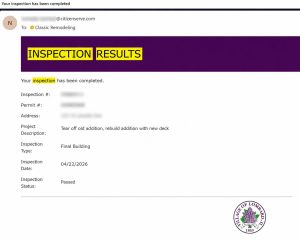
"Real Permit & Inspection Records From Actual Classic Remodeling Projects"
While that may save money initially, it can create significant problems later if work must be corrected, removed, or brought up to code.

In our experience, doing the project correctly the first time almost always costs less than fixing it later.

We have personally encountered situations where homeowners hired contractors to complete projects without permits, only to have the local municipality discover the unpermitted work. In some cases, homeowners were required to open walls, remove completed work, or even demolish portions of newly constructed structures so inspectors could verify compliance with current building codes.

We’ve also seen situations where homeowners were instructed by their municipality to remove newly constructed structures entirely because permits were never obtained.

Beyond the cost of corrective work, municipalities may assess additional penalties, double permit fees, reinspection fees, and administrative charges. What initially appeared to be a cost-saving measure often becomes significantly more expensive than obtaining the proper permits from the beginning.

3. Have You Completed This Type of Project Before?

Not all remodeling projects are the same.

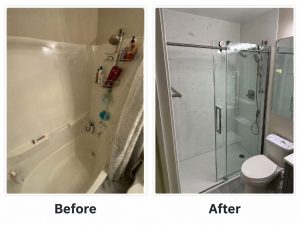
A contractor who primarily installs flooring may not be the best choice for a bathroom remodel involving plumbing, electrical work, waterproofing, tile installation, inspections, and building code requirements.before and after bathroom remodel
Ask to see:

  • Photos of completed projects
  • Before-and-after pictures
  • References from previous customers
  • Similar projects to yours

At Classic Remodeling, when prospective clients request references, we typically contact previous customers and ask whether they would be comfortable sharing feedback about their experience. If they agree, we facilitate an introduction so potential clients can hear directly from homeowners who have worked with us.

A contractor should be proud to show their work.

4. Do Your Online Reviews Look Real?

Online reviews can be helpful—but they should be viewed carefully.

Over the last several years, we’ve noticed what appears to be a growing trend of review manipulation throughout many industries, including home remodeling.

That’s why we encourage homeowners to look beyond the star rating.

Ask yourself:

  • Are reviews detailed and specific?
  • Do reviewers mention actual projects?
  • Are there photos attached?
  • Have reviews been collected consistently over time?
  • Does the company respond professionally to feedback?

 

online review

Many established and reputable companies don’t have a perfect 5.0-star rating. In fact, businesses with hundreds of reviews often fall somewhere between 4.7 and 4.9 stars because real companies occasionally encounter misunderstandings, scheduling issues, or situations where expectations differ.

A large number of authentic reviews is often more meaningful than a perfect score.

Look for consistency, transparency, and a long history of customer satisfaction rather than chasing a flawless rating.

5. Can You Provide a Current Certificate of Insurance (COI)?

This is one of the most important questions a homeowner can ask.

Any professional contractor should be able to provide a current Certificate of Insurance (COI) upon request.

You can even ask to be listed as a Certificate Holder on the document.

A COI typically shows whether the company carries:

  • General Liability Insurance
  • Commercial Auto Insurance
  • Workers’ Compensation Insurance

If a company has employees, workers’ compensation coverage is generally required under Illinois law.

Ask the contractor to send you the certificate and review it carefully.

If workers’ compensation coverage is not shown, ask whether they have another policy or additional certificate through a different insurance carrier.

If a contractor claims to have employees but cannot provide proof of workers’ compensation coverage, that should raise questions.

From our perspective, the ability to promptly provide proof of insurance is one of the clearest indicators of a company’s professionalism and commitment to operating legitimately.

6. Do You Provide a Workmanship Warranty?

workmanship warrantyThis is a question many homeowners don’t think to ask until after the project is complete.

Every professional remodeling contractor should stand behind their work.

While warranty terms vary from company to company, it is common for reputable contractors to provide a workmanship warranty that covers their craftsmanship for a period of time after the project is completed. Many companies, including Classic Remodeling, provide warranty information within their service agreements so homeowners understand what level of support they can expect after the project is finished.

The specific details of any warranty are less important than the principle behind it.

When a homeowner invests thousands, or even tens of thousands of dollars into a remodeling project, they should reasonably expect that if an adjustment, correction, or service-related issue arises shortly after completion, the contractor will be available to address it.

A workmanship warranty demonstrates confidence in the quality of the work being performed and a commitment to customer satisfaction long after the final payment has been been made.

In our experience, this is one of the areas where low-cost contractors often fall short.

A contractor who is focused solely on being the cheapest bidder may not have the systems, staff, or financial stability necessary to support customers after the project is complete. In some cases, homeowners discover that the contractor they hired is no longer answering phone calls, has changed business names, or has simply moved on.

Unfortunately, homeowners don’t always realize they purchased a “cheap and fast” project until months after the work has been completed.

That’s when small issues begin to appear.

A door may need adjustment. A fixture may require attention. Caulking may need touch-up. A cabinet door may settle slightly. These are often minor items, but they reveal the difference between hiring someone to perform work and hiring a professional company that stands behind its craftsmanship.

When interviewing contractors, don’t just ask about the project itself. Ask what happens after the project is complete.

The answer can tell you a great deal about the company you’re considering hiring.

What Does "Licensed, Bonded & Insured" Actually Mean?

Over the years, we’ve had many prospective clients call and ask a simple question:

“Are you licensed, bonded, and insured?”

The answer is important, but the phrase itself is often misunderstood.

Many contractors can answer “yes” to that question, yet the details behind that answer may vary significantly.

For example, a contractor may be bonded in one municipality but not another. If you’re located in Naperville and the contractor is only bonded in Glen Ellyn, that bond may provide little practical value for your project.

Similarly, many contractors carry General Liability insurance because it is relatively inexpensive. However, homeowners should ask whether the coverage limits are sufficient for the size and scope of their project.

Insurance isn’t simply about having a policy—it’s about having the right policy.

Another common misconception involves licensing.

Many homeowners are surprised to learn that Illinois does not issue a statewide general contractor license in the same manner that it licenses electricians, plumbers, or other specialty trades.

An experienced remodeling contractor understands these requirements and knows how to properly coordinate licensed trades, permits, inspections, and building code compliance.

One must be a true professional to navigate these requirements while keeping the homeowner’s best interests in mind.

Unfortunately, not every contractor operates with those values.

That’s why asking detailed questions, and requesting documentation is often far more valuable than relying solely on industry buzzwords.

A Story We'll Never Forget

One story in particular has stayed with us over the years.

A homeowner from Glen Ellyn contacted us about a bathroom remodeling project that another contractor had started.

The project itself was straightforward—a standard bathtub replacement with a tile surround.

She explained that she had paid the requested down payment. As the work progressed, the contractor requested additional payments, which she provided. Then, suddenly, the contractor stopped showing up.

At first, he claimed he was in the hospital.

Later, he stopped responding altogether.

She eventually realized she needed to find someone else to finish the bathroom.

When she called our office, something happened that we still remember to this day.

About five minutes into the conversation, she began crying.

The financial loss was painful. The unfinished bathroom was stressful. But perhaps most difficult of all was the feeling of being taken advantage of and losing trust in an industry she depended on.

When our estimator visited the home, it became obvious why the original contractor had disappeared.

The tile installation had been done incorrectly.

The seams were uneven. The layout was inconsistent. The installation lacked the basic workmanship expected from a professional tile installer.

The contractor had created a situation he didn’t know how to fix.

Unfortunately, there was only one proper solution.

Everything had to be removed and rebuilt from the beginning.

That is exactly what we did.

We demolished the failed installation, rebuilt the bathroom correctly, and completed the project.

Sadly, this is not an isolated story.

Over the years, we have heard dozens of similar stories from homeowners throughout the Chicagoland area.

These experiences are one of the primary reasons contractors often have a poor reputation.

At Classic Remodeling, fighting against that reputation has been part of our mission since day one.

In fact, it is one of the reasons our company was established in the first place.

We believe homeowners deserve honesty, professionalism, accountability, and quality workmanship. We want our clients to know that trustworthy contractors still exist.

When we hear stories like this, we genuinely feel for our clients because we understand the emotional and financial toll these situations create.

If this article helps even one homeowner avoid a similar experience, then sharing these stories is worthwhile.

One pattern we see repeatedly is homeowners trying to save a few dollars upfront, only to discover later that they must pay to complete the project a second time. In many cases, the total cost ends up exceeding the highest bid they originally received.

Don't Let Price Be the Only Factor

One of the most common situations we encounter is a homeowner selecting the lowest bid, only to call us later after the project has stalled, the contractor has disappeared, or the quality of work is unacceptable.

Price matters.new bathroom look

But value matters more.

A professional remodeling contractor invests in:

  • Qualified employees
  • Insurance coverage
  • Permits
  • Training
  • Specialized tools
  • Quality materials
  • Customer service
  • Continuing education
  • Warranty support

Those costs are reflected in pricing, but they also help ensure the project is completed safely, professionally, and correctly.

At the End of the Day

Hiring a remodeling contractor is a significant decision that can impact your home, finances, and peace of mind.

While licensing, bonding, and insurance should always be verified, we believe homeowners should also take the time to understand how a contractor operates their business.

  • Ask questions.
  • Request documentation.
  • Review previous work.
  • Talk to past clients.
  • Read reviews carefully.
  • Understand how permits are handled.
  • Verify insurance coverage.
  • Ask about warranties.
  • And trust your instincts.

The right contractor will welcome those questions because they understand that trust is earned—not assumed.

At Classic Remodeling, we encourage every homeowner to do their homework before hiring any contractor, including us. An informed homeowner is far more likely to enjoy a successful remodeling experience and a finished project they’ll be proud of for years to come.

About Classic Remodeling
Classic Remodeling is a full-service remodeling contractor serving homeowners throughout DuPage County and the western suburbs of Chicago, specializing in bathroom remodeling, kitchen remodeling, basement finishing, home additions, and accessibility remodeling solutions.

Claim Your Free Quote

Ready to Transform Your Space?

Let’s discuss how Classic Remodeling can help elevate your property with our premium remodeling services. Our team is ready to bring your vision to life with the quality craftsmanship and attention to detail that defines our work.